The Innovator's Prescription: A Disruptive Solution for Health Care by Clayton M. Christensen & Jerome H. Grossman M.D. & Jason Hwang M.D
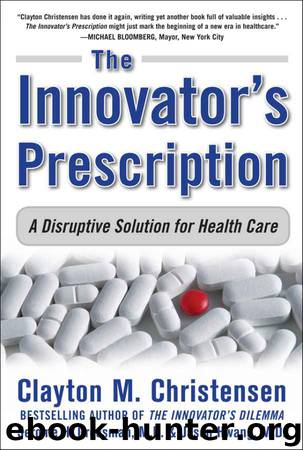
Author:Clayton M. Christensen & Jerome H. Grossman M.D. & Jason Hwang M.D.
Language: eng
Format: mobi
Publisher: McGraw-Hill Education
Published: 2008-12-24T14:00:00+00:00
The second set of entities that could integrate a new value network are large providers that create and knit together underneath their corporate umbrellas all of the necessary elements of the new value network. There are several important characteristics of such integrated health systems.
First, they operate their own insurance and payments systems. Patients or purchasers in the system pay a fixed fee, typically yearly, that covers the cost of all care they might need. Second, the physicians are essentially employees of the system, not independent businesspeople. Third, the caregiving institutions in the system are apt to use focused business models, as described in Chapters 3 through 5. They can operate a limited number of general hospitals, while rationally siphoning work out to coherent solution shops and value-adding process clinics, outpatient clinics, and even retail clinics. And they have created and operate an information system that glues these different providers together to properly coordinate care. Finally, these firms are large employers themselves.
Note that we're expecting these integrated fixed-fee providers to operate the disruptees as well as the disruptors. This is a demanding but not an impossible expectation. Typically, we'd expect that the provider of a service, such as a hospital, would not disrupt itself by launching a chain of ambulatory and retail clinics, for example. But the unique structure of an integrated fixed-fee provider actually creates the incentive to shift care to the most cost effective venues possible—and to create those venues if they do not exist. The structure also encourages them to spend more money on a coherent solution shop diagnosis for a chronic illness, or to prevent that chronic illness in the first place, because it has the scope to realize savings elsewhere and over time. In general, most patients perceive higher switching costs across providers than across health assistance plans (our term for reimbursement and insurance plans). As a result, members of integrated fixed-fee provider systems tend to remain in these systems much longer than in a typical nonintegrated health plan. This gives the integrated system a much longer time horizon over which to evaluate the profitability of investments in members' long-term health.
It is easier for integrated providers such as these to create outpatient centers that disrupt hospitals, and to enable nurse practitioners to disrupt primary care physicians, who themselves can be encouraged to disrupt the specialists—because the executive teams at the center possess a systems view. They don't need to orchestrate a disruptive value network. They can create it. By fiat, they can declare the format by which electronic health records will be kept, so that these records are instantly accessible wherever the patient goes within the system. Some provider organizations—including most that arose during the surge of loosely defined integrated delivery networks of the late 1980s and 1990s—are diversified across all of these activities, but they are not managerially integrated, and thus each of their units operates with relative autonomy. It is unlikely that this latter type of organization is capable of putting all of these disruptive pieces together.
Download
This site does not store any files on its server. We only index and link to content provided by other sites. Please contact the content providers to delete copyright contents if any and email us, we'll remove relevant links or contents immediately.
The Brazilian Economy since the Great Financial Crisis of 20072008 by Philip Arestis Carolina Troncoso Baltar & Daniela Magalhães Prates(328455)
International Integration of the Brazilian Economy by Elias C. Grivoyannis(111453)
The Art of Coaching by Elena Aguilar(53472)
Flexible Working by Dale Gemma;(23329)
How to Stop Living Paycheck to Paycheck by Avery Breyer(19794)
Thinking, Fast and Slow by Kahneman Daniel(12452)
The Acquirer's Multiple: How the Billionaire Contrarians of Deep Value Beat the Market by Tobias Carlisle(12395)
The Radium Girls by Kate Moore(12120)
The Art of Thinking Clearly by Rolf Dobelli(10638)
Hit Refresh by Satya Nadella(9212)
The Compound Effect by Darren Hardy(9092)
Tools of Titans by Timothy Ferriss(8520)
Atomic Habits: Tiny Changes, Remarkable Results by James Clear(8450)
Turbulence by E. J. Noyes(8143)
A Court of Wings and Ruin by Sarah J. Maas(7996)
Change Your Questions, Change Your Life by Marilee Adams(7876)
Nudge - Improving Decisions about Health, Wealth, and Happiness by Thaler Sunstein(7775)
How to Be a Bawse: A Guide to Conquering Life by Lilly Singh(7564)
Win Bigly by Scott Adams(7286)
